
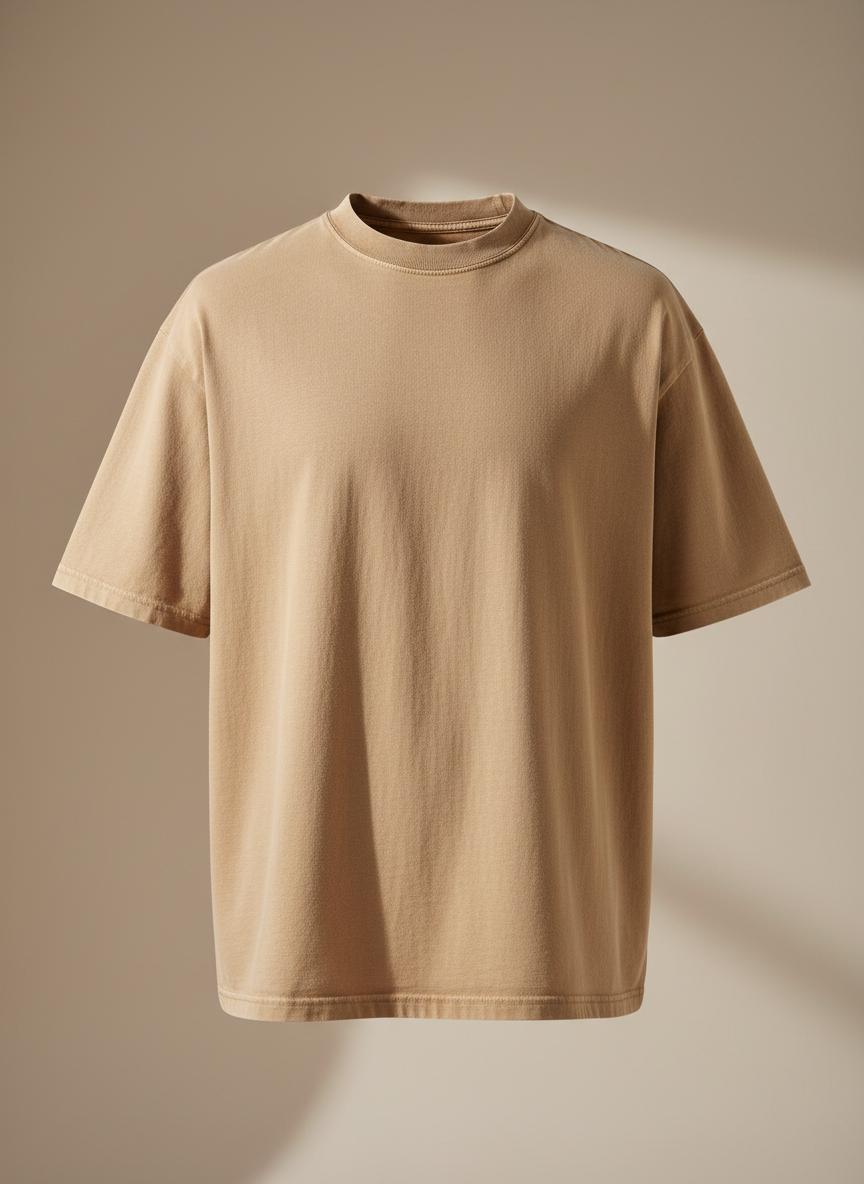
Ask ten people what it costs to manufacture a t-shirt and you will get answers from $1 to $20 — and all ten can be right, because "a t-shirt" spans everything from a 140 GSM promotional tee to a 280 GSM garment-dyed heavyweight with puff print and custom woven labels. This guide gives you the real 2026 numbers we quote every day at our factory, so you can budget accurately before you talk to any manufacturer.
The Short Answer
| T-shirt type | Factory-direct cost (100 pcs) | Typical retail |
|---|---|---|
| Basic promotional tee (140–160 GSM, 1-color print) | $2.80–4.00 | $15–20 |
| Standard brand tee (180–200 GSM, quality print, custom label) | $4.00–5.50 | $25–35 |
| Heavyweight streetwear tee (220–280 GSM, boxy fit, puff/embroidery) | $5.50–9.00 | $35–50 |
| Premium specialty (organic cotton, garment-dye, all-over sublimation) | $8.00–14.00 | $45–70 |
Those are cut-and-sew prices from an export factory in Pakistan — the same tier of production used by Western brands — not decorated wholesale blanks. Now let's break down where every dollar goes.
Cost Component 1: Fabric (45–55% of the price)
Fabric is the biggest line item, driven by three things:
- Weight (GSM): a 240 GSM tee simply contains ~50% more cotton than a 160 GSM tee. Heavyweight costs more because it literally is more. See our GSM guide for how weight changes hand-feel.
- Fiber: standard ring-spun cotton is the baseline; combed cotton adds ~10%; organic certified cotton adds 25–40%; performance polyester blends for activewear tees run similar to combed cotton.
- Treatments: enzyme wash, garment dye, and acid wash add $0.60–1.50 per shirt but create the vintage look that sells at premium prices.
Cost Component 2: Cut & Sew Labor (20–25%)
A basic crew-neck is one of the simplest garments to sew, which is why unit economics are so quantity-sensitive: the factory sets up the same line whether it runs 50 shirts or 5,000. Complexity adds cost — side seams vs tubular, contrast stitching, hem details, or a boxy pattern with drop shoulders all add sewing minutes. This is also where country choice matters most: the same shirt sewn in the USA carries $6–12 of labor; in Pakistan's Sialkot cluster, $0.80–1.60 with equivalent export-grade QC.
Cost Component 3: Decoration (10–25%)
| Method | Cost per shirt (100 pcs) | Best for |
|---|---|---|
| Screen print (1–2 colors) | $0.60–1.20 | Bold logos, big runs |
| Screen print (4+ colors) | $1.50–3.00 | Complex graphics |
| Puff print | $1.20–2.50 | Raised streetwear texture |
| Embroidery (chest logo) | $0.80–2.00 | Premium branding |
| All-over sublimation | $2.00–4.00 | Full-print polyester designs |
| DTG (direct-to-garment) | $2.50–5.00 | Photo prints, tiny runs |
Not sure which method fits your design? Our print method comparison covers durability, color limits, and cost curves for each.
Cost Component 4: Trims, Labels & Packaging (5–10%)
This is the cheapest way to look expensive: woven neck label ($0.10–0.25), printed care label ($0.03–0.08), hang tag ($0.08–0.20), poly bag ($0.04–0.10). A fully private-labeled shirt costs roughly $0.30–0.60 more per unit than an unbranded one — and retails for $10+ more because it reads as a real brand.
How Quantity Changes Your Price
| Order size | 220 GSM custom tee, printed + labeled |
|---|---|
| 50 pieces (our MOQ) | $9.50–12.50 |
| 100 pieces | $8.50–11.00 |
| 300 pieces | $7.10–9.00 |
| 1,000 pieces | $6.00–7.50 |
The curve flattens after ~500 pieces — which means new brands lose surprisingly little by starting at 50–100 pieces, and gain enormously in reduced inventory risk. Model your exact scenario with the MOQ calculator.
Don't Forget Landed Cost
The factory price is not your final cost. Add shipping and duties to get your true "landed" unit cost:
- Express air (DHL/FedEx, 3–7 days): roughly $0.80–1.50 per shirt at 100-piece volumes, falling fast with quantity.
- Duties: for the USA, cotton t-shirts carry about 26.5% duty on the goods value as of October 2026 — the 16.5% MFN rate plus the 10% Section 301 forced-labor tariff applied to Pakistani goods since 24 July 2026. A DDP (Delivered Duty Paid) quote bundles this so there are no surprises.
Example: an $8.80 heavyweight tee + $1.10 shipping + $2.33 duty = $12.23 landed. At a $38 retail price that is a 68% gross margin — healthy enough to fund real marketing. For the full picture including samples, development and packaging, read our complete manufacturing cost breakdown.
USA vs China vs Pakistan vs Bangladesh
| Country | Same 220 GSM tee (100 pcs) | Typical MOQ | Watch out for |
|---|---|---|---|
| USA / EU domestic | $12–20 | 24–100 | Cost kills margins at startup scale |
| China | $4.50–7.00 | 300–500 | High MOQs, rising costs, trading-company markups |
| Bangladesh | $3.50–5.50 | 1,000+ | Built for volume, not small custom runs |
| Pakistan (Sialkot) | $6.50–9.50 | 50 (FABRIOZA) | Choose an export-certified factory |
Pakistan's edge for small brands is the combination: China-level pricing with MOQs an order of magnitude lower, plus a cotton supply chain on the doorstep. More on that in our Sialkot manufacturing guide.
Frequently Asked Questions
How much does it cost to make one t-shirt?
At production quantities of 100 pieces, a standard custom brand tee costs $4.00–5.50 to manufacture, a heavyweight streetwear tee $5.50–9.00, and a basic promotional tee $2.80–4.00. One-off single shirts via DTG printing cost $12–25 because no production economies apply.
Why do heavyweight t-shirts cost more?
A 240 GSM heavyweight tee contains roughly 50% more cotton than a standard 160 GSM tee, and heavier fabric is slower to cut and sew. Fabric is about half of a t-shirt's cost, so weight moves the price more than any other factor.
What is the cheapest way to manufacture t-shirts for a brand?
Order factory-direct (no trading company markup), start with 1–2 colorways to hit better quantity pricing, use 1–2 color screen prints, and ship by sea only when ordering 500+ pieces. Avoid going below 180 GSM to save money — thin fabric costs you reorders.
How many t-shirts do I have to order from a factory?
Most overseas factories require 300–1,000 pieces per design. FABRIOZA's minimum is 50 pieces per style, which covers a full size run (S–XXL) and keeps a first order around $300–450 for standard tees.
What profit margin should a t-shirt brand have?
Aim for at least 70% gross margin on landed cost — e.g., a shirt that lands at $8 should retail for $28+. Direct-to-consumer streetwear brands typically run 75–85% gross margins to fund content and paid acquisition.
Want an Exact Price for Your T-Shirt?
Send us your design or reference image and get a factory-direct quote within 24 hours - MOQ from 50 pieces, custom labels included.
Prefer email? info@fabrioza.com — we reply within one working day.